
AECS Insights / Cosmetic gynaecology
Surgical vs non-surgical cosmetic gynaecology training: what doctors should compare
“Surgical” and “non-surgical” do not identify two standard courses or two levels of competence. They group different interventions under broad headings. For a doctor selecting education, the useful comparison is what knowledge, evidence review, supervised activity and assessment a particular topic requires. A non-surgical label does not establish low risk or proven benefit, and a surgical topic on a timetable does not mean delegates practise surgery.
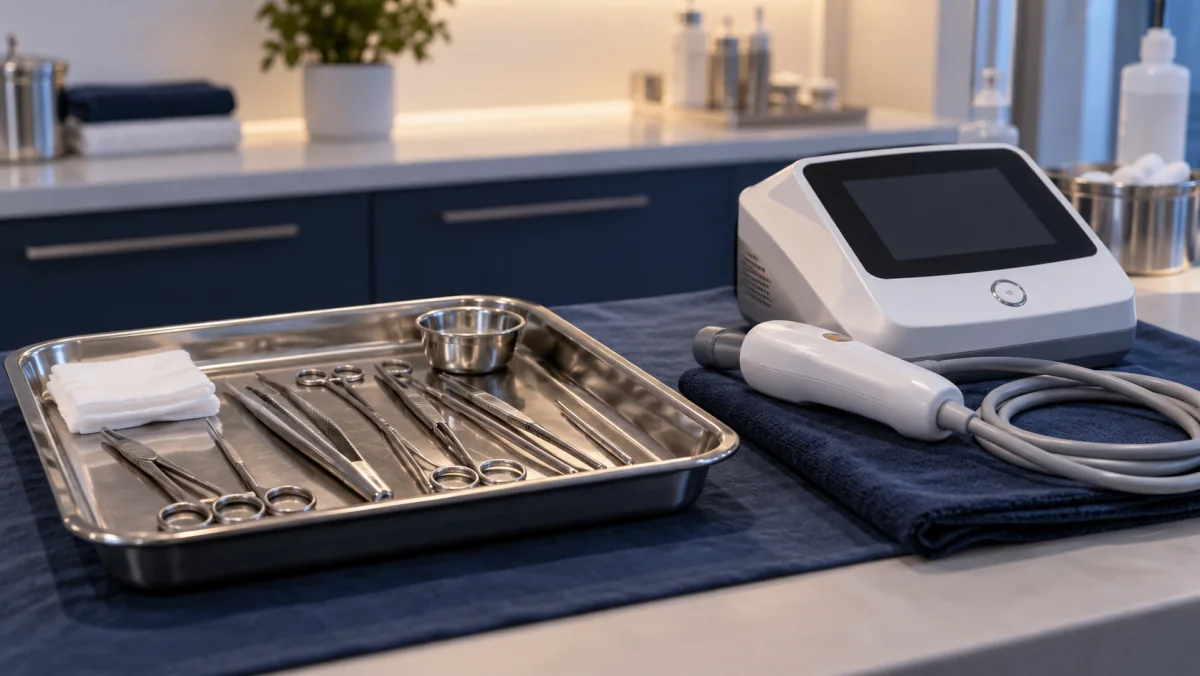
This guide uses examples at curriculum level. They illustrate questions a doctor might put to a programme; they are not a list of AECS teaching activities or recommendations to offer any intervention. It gives no clinical technique or patient-specific advice.
Understand what the categories contain
ACOG’s 2020 Committee Opinion No. 795 on elective female genital cosmetic surgery names operations such as labiaplasty and vaginoplasty. It also discusses energy-based devices, including laser and radiofrequency, marketed for vaginal cosmetic or “rejuvenation” uses. These names make the curriculum distinction more concrete, but neither a procedure name nor a device category tells you whether a proposed use is appropriate, authorised or effective.
A programme might discuss labiaplasty as an example of surgical decision-making, show an operation, offer simulation, or arrange supervised clinical experience. Each is a different educational claim. A programme might discuss an energy-based device as a topic in evidence appraisal, demonstrate equipment or propose practice. “Non-surgical” does not collapse those activities into one easy skill.
These categories can also hide different purposes. A clinician may address pain, injury, prolapse or another diagnosed condition through clinically indicated care; elective appearance or function claims raise a different evidence and consent discussion. ACOG’s opinion distinguishes clinical indications from elective cosmetic claims. A course should do the same rather than place them together under a reassuring marketing label.
What a surgical curriculum needs to make clear
If an operation such as labiaplasty or vaginoplasty is a teaching topic, the curriculum should identify its intended audience and prior surgical foundation. Anatomy, reasons for considering or not considering an intervention, alternatives, consent, perioperative care, complications and follow-up belong to the educational discussion. These are questions of clinical judgement and responsibility, not instructions for performing an operation.
The mode of teaching matters. A case seminar can test whether a doctor can appraise a claim and discuss alternatives. Observation can show how a surgical team makes decisions, but the observer has not operated. Simulation can permit controlled rehearsal of a defined skill. Supervised clinical participation requires a suitable learner, patient-care governance and direct feedback. An assessment must say which of these outcomes it actually tested.
The RCOG structured laparoscopic simulation curriculum is an example of separating theoretical objectives, simulation exercises and observed assessment in a different surgical-training context. It does not certify any cosmetic intervention or AECS course. Its relevance here is educational design: an operative topic deserves more specificity than a checkbox labelled “hands-on.”
A doctor who lacks the surgical prerequisites may reasonably choose evidence and counselling education first. A doctor with relevant operative training may need a narrower, supervised objective. Neither starting point can be inferred from a course title.
What an energy-based topic needs to make clear
For a laser or radiofrequency topic, the central educational questions include the particular device and intended use, the evidence for a claimed outcome, known limitations and harms, maintenance of competence, and the authorisation relevant to the country of practice. Device familiarity and evidence for a treatment claim are separate matters. A demonstration of equipment does not prove that an indication is supported or that a delegate can use it independently.
ACOG’s 2020 Committee Opinion No. 795 cites the FDA’s 2018 safety communication about energy-based devices used for vaginal “rejuvenation” or cosmetic procedures. That is a US regulatory and evidence context, not a statement about UAE device approval or licensing. A programme should identify the jurisdiction and claim it is teaching, and allow the learner to examine the actual evidence and authorisation. Avoid generalising a clearance for one use to another use, or a claim about one device to all devices in its category.
For a non-surgical topic involving a material or product rather than an energy-based device, the exact curriculum questions will differ. The programme should identify the product class, the proposed indication, evidence and safety information, and the practical activity offered. The broad label “non-surgical” is too thin to establish any of these. No device settings, injection method or product-specific technique is needed to make a sound course-selection decision.
Treat evidence and patient governance as part of the education
ACOG describes limited high-quality evidence for several elective cosmetic claims and discusses potential harms and the importance of informed counselling. This does not imply that every surgical or non-surgical intervention has the same evidence base. It means a course should distinguish a documented clinical indication from an elective claim, and should show the quality and limits of evidence for each topic it includes.
Ask how the programme handles a learner who questions an advertised benefit. Are alternatives, uncertainty, adverse outcomes and follow-up discussed? Are before-and-after images or testimonials being used as illustrations rather than proof of efficacy? A doctor needs a way to evaluate a claim, not only learn its marketing language.
If patients are involved in training, consent for care is distinct from consent for a delegate’s observation or participation, and from permission to use images. The programme should explain who remains responsible for patient selection, care and follow-up. The WHO patient-safety curriculum supports teaching safety and communication in professional education; it is not evidence of an intervention’s effectiveness or of AECS patient arrangements.
Read activity and assessment claims precisely
A prospectus may say a topic is “covered” or “demonstrated.” That can mean anything from a lecture to observed practice. For a surgical topic, ask whether the learning outcome is evidence appraisal, anatomy and decision-making, observation, simulation or directly supervised participation. For a device topic, ask whether the goal is critical appraisal, understanding device governance, observation or supervised use. The topic-specific goal determines the suitable assessment.
A knowledge quiz can test concepts. A case discussion can test reasoning about indications and uncertainty. A simulation assessment can document performance in a model setting. Observed clinical work can document performance in the particular setting, if appropriately governed. None of these alone grants a new scope of practice. The certificate should state the activity and assessment completed, not imply competence across every topic named on a flyer.
For a hypothetical two-topic course, imagine a labiaplasty session presented through case discussion and a laser topic shown in a demonstration. A delegate has learned about two topics but has not necessarily practised either. If the second topic includes supervised simulation, that adds active practice on a model; it still does not establish treatment efficacy or patient-care competence. This example describes no AECS course.
Compare the pathways by their real educational differences
Swipe horizontally to view all columns.
| Decision dimension | Surgical example: labiaplasty or vaginoplasty as a curriculum topic | Non-surgical example: energy-based device topic |
|---|---|---|
| Starting competence | Relevant anatomy, surgical background and operative governance must be defined for any practical participation. | Relevant clinical background, device-specific training and intended-use governance must be defined; “non-surgical” is not a prerequisite waiver. |
| Core knowledge | Indications versus elective claims, alternatives, anatomy, perioperative and follow-up responsibilities. | Intended use, evidence for each claim, device-specific limitations, adverse effects and authorisation. |
| Practical learning | Case reasoning, observation, simulation or supervised operative participation are separate outcomes. | Evidence appraisal, demonstration, simulation or supervised device use are separate outcomes. |
| Evidence question | What supports the claimed benefit and risk for this particular operation and indication? | What supports the claimed benefit and risk for this particular device and use? |
| Appropriate assessment | Match knowledge/case assessment or observed performance to the specific activity taught. | Match evidence reasoning, device knowledge or observed performance to the specific activity taught. |
| Responsibility afterward | Patient selection, consent, complications and follow-up remain governed by the doctor’s role and setting. | Device/use approval, consent, adverse-effect response and follow-up remain governed by the doctor’s role and setting. |
The table cannot rank categories by safety or say that one generic course can qualify a doctor for both. Intervention-specific evidence and the learner’s starting competence decide the educational path.
Choose the next educational step
A doctor exploring the field may first need a course that critically explains elective claims, clinical indications and patient communication. Someone with relevant surgical training may need a defined, supervised operative-learning goal. A doctor evaluating an energy-based topic may need careful evidence and regulatory appraisal before any practical training decision. In each case, request the current topic-level plan and compare what is taught, what the delegate does, and what is assessed.
AECS lists a cosmetic gynaecology course in Dubai. Compare its current topic-level plan with the learning distinctions above.
Questions doctors commonly ask
Is non-surgical training automatically lower risk? No. The evidence, risks and competence required depend on the particular intervention and intended use, not the category name.
Can one course introduce both categories? Yes, but an introduction, observation and assessed practical competence are different achievements for each topic.
Does a course certificate permit new independent practice? A certificate records what its issuer states. Professional permissions and clinical privileges depend on the relevant authority and setting.
This article supports professional education decisions, not clinical procedures or patient advice.